
I'm Dr. Ivan Bracic, and I've spent more than 30 years treating injury patients, a lot of them after car accidents here in Southwest Florida. The single most common thing people ask me in the days after a crash is some version of "why does my head hurt, and should I be worried?" Headaches after a car accident usually fall into six types, and the honest answer is that a few of them are routine and one or two of them need attention fast. So let me walk you through what I look for. If you were hurt in a crash, our team provides same-day auto accident care in Fort Myers and Lehigh Acres and documents everything your PIP claim needs.
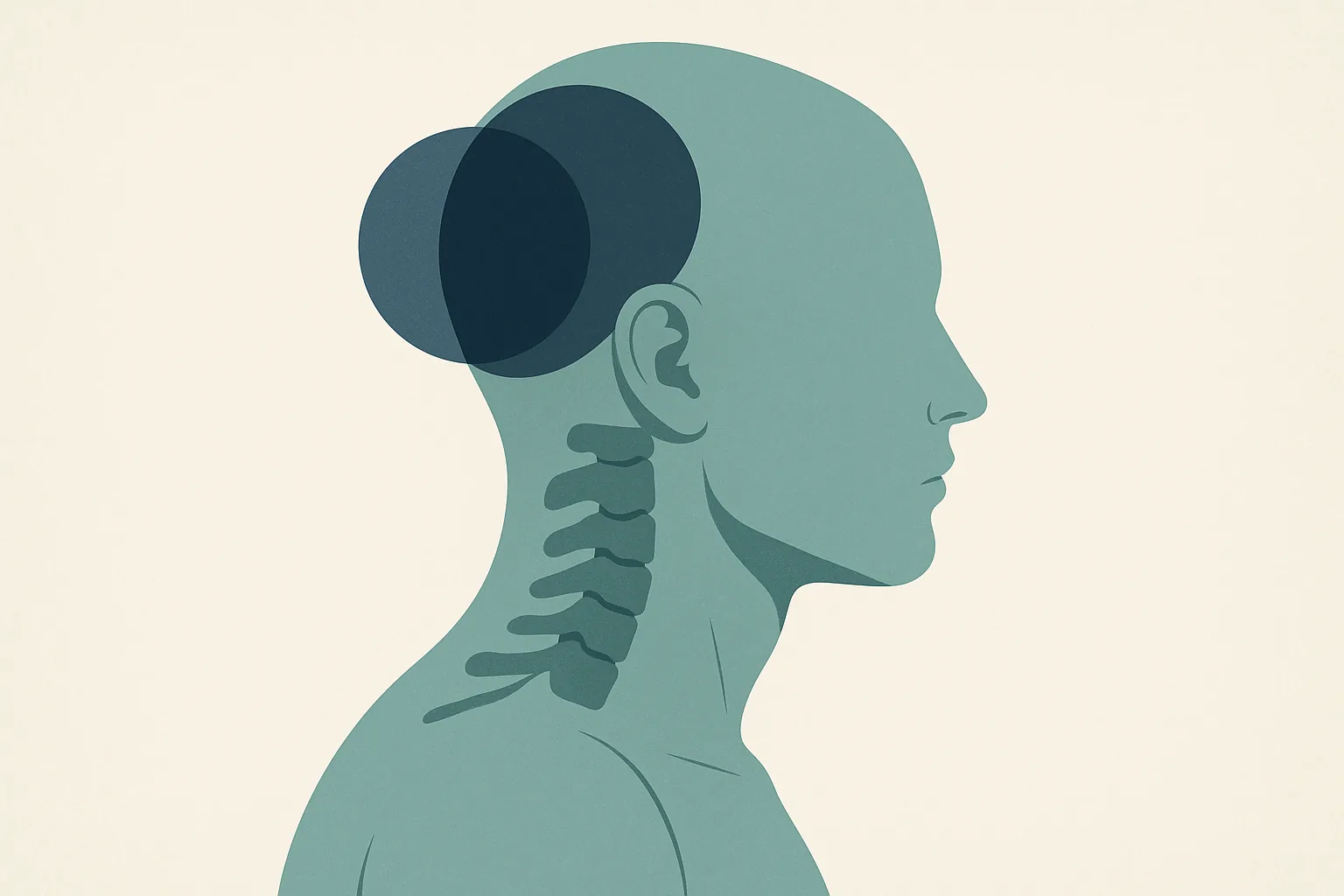
A headache after a collision is not one thing. It can start in the joints of your neck, at the base of your skull, in a strained muscle, or from the brain being jolted inside the skull. The location, the timing, and the other symptoms that come with it tell me a lot. Here are the six types I see most, in plain language, and how to tell them apart.
The 6 types of headaches after a car accident
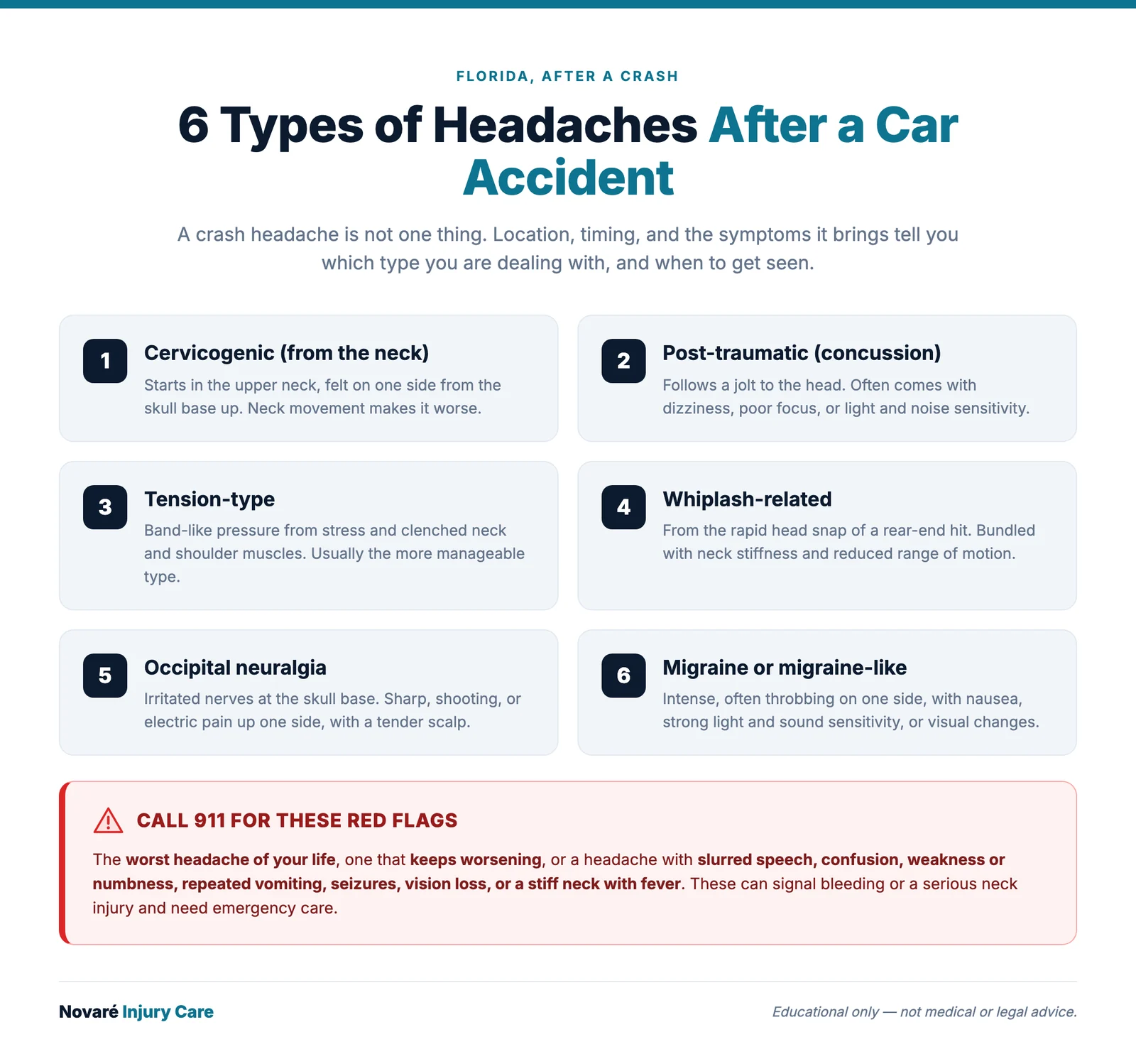
The most common headaches after a car accident are cervicogenic, post-traumatic (concussion), tension, whiplash-related, occipital neuralgia, and migraine. Most trace back to the neck or the head impact of the crash. Each one feels a little different, and knowing which is which helps you and your provider treat the right problem instead of guessing.
Below I break down all six. If any of them come with the red-flag symptoms I list further down, skip the reading and get emergency care.
1. Cervicogenic headache (from the neck)
This is the one I see most often after a crash. A cervicogenic headache actually starts in the joints, discs, or nerves of the upper neck, but you feel the pain in your head. It usually sits on one side, often starting at the base of the skull and wrapping up toward the forehead or behind the eye.
The tell is that neck movement makes it worse. Turning your head, looking up, or holding one position for a while tends to flare it. Because the source is the neck, treating the neck is what resolves it, which is why an accurate diagnosis matters before anyone reaches for pain pills alone.
2. Post-traumatic headache (concussion-related)
A post-traumatic headache follows a blow or a jolt to the head, which a car accident delivers easily, even without your head striking anything. When the brain moves suddenly inside the skull, you can get a concussion, and headache is its most common symptom.
Watch for the company it keeps: dizziness, trouble concentrating, sensitivity to light or noise, sleep changes, or feeling "off." A concussion is a real injury that deserves a prompt evaluation, and this is the headache type I most want people to take seriously rather than push through.
3. Tension-type headache
Tension headaches are the familiar band-like pressure around the head, often described as a tight cap or a vice. After a crash, they come from the stress of the event and from the muscles of the neck and shoulders clenching against the impact.
These tend to be the more manageable ones, and they often ease within days to a couple of weeks as the muscles settle and the stress fades. That said, I still like to confirm the tension headache isn't sitting on top of a neck injury that needs its own attention.
4. Whiplash-related headache
Whiplash is the rapid back-and-forth snap of the head that a rear-end collision causes, and headache is one of its hallmark symptoms. It overlaps with the cervicogenic type, but I list it on its own because whiplash is so common in crashes and so often missed.
The soft tissues, ligaments, and joints of the neck get overstretched, and the resulting headache usually comes bundled with neck stiffness, reduced range of motion, and sometimes shoulder or upper-back pain. If you were rear-ended, this is high on my list. Our whiplash treatment is built specifically for these injuries.
5. Occipital neuralgia
Occipital neuralgia is a headache driven by irritation of the occipital nerves, which run from the top of the spine up through the back of the head. A crash can compress or inflame these nerves, and the pain has a distinct quality.
People describe it as sharp, shooting, electric, or stabbing, usually starting at the base of the skull and shooting up one side of the head, sometimes toward the scalp or behind the ear. The scalp can feel tender to the touch. It is less common than the first few types, but its jolting, nerve-like character usually sets it apart.
6. Migraine or migraine-like headache
A crash can trigger migraines, either in someone who already gets them or, less often, as a new pattern after a head injury. These are more intense than a tension headache and often throb on one side.
The migraine signature is the extras: nausea, vomiting, strong sensitivity to light and sound, and sometimes visual changes like flashing spots or blind patches beforehand. Because some of those overlap with concussion warning signs, a new or severe migraine-like headache after a crash is worth a prompt look rather than reaching for what worked before.
When a headache after a crash is an emergency
Some headaches need immediate care, not a wait-and-see approach. Call 911 or get to the nearest emergency room right away if a headache after your accident comes with any of these red flags, because they can signal bleeding in or around the brain or a serious neck injury.
- The worst headache of your life, or one that comes on suddenly and severely.
- A headache that keeps getting worse over hours instead of easing.
- Slurred speech, confusion, or trouble staying awake.
- Weakness, numbness, or tingling in the face, arm, or leg.
- Repeated vomiting, seizures, or loss of consciousness.
- Vision loss or double vision, or a stiff neck with a fever.
According to the CDC's guidance on concussion and traumatic brain injury, warning signs like these after a head injury are reasons to seek emergency care. When in doubt after a crash, err toward getting checked. A headache that seems minor but carries one of these signs is not the time to tough it out.
Why you should get evaluated even if the headache seems mild
Here is the part people underestimate. Adrenaline can mask a head or neck injury for hours or even a day or two after a collision, so plenty of the headaches I treat didn't start until the patient got home and settled down. A late-arriving headache is normal, and it doesn't mean the injury is minor.
Getting seen early does two things at once. It lets a provider identify what's actually causing the pain, whether that's the neck, a concussion, or an irritated nerve, so the treatment targets the real problem. First-visit diagnostic imaging helps rule out the serious stuff and pin down the source instead of guessing.
There's a Florida-specific reason to move quickly too. To keep your Personal Injury Protection (PIP) medical benefits, Florida law generally requires that you receive initial care from a qualified provider within 14 days of the crash. Wait past that window and you can lose access to those benefits even when your injury is real and clearly crash-related. If you want the full picture, I walk through the whole sequence in our guide to the 7 things to do after a car accident in Florida.
A note on scope: this article explains the common types of headaches after a crash and how to think about them. It is educational, not medical or legal advice. For your specific symptoms and your specific policy, rely on a qualified provider and a licensed attorney.
The questions I hear most from crash patients about headaches, answered in plain language.
Hurt in a crash and dealing with headaches? Get evaluated today
You don't have to guess at what's causing your headache, and you shouldn't let the 14-day clock run out while you wait to see if it passes. If you've been in a car accident in Southwest Florida, our auto accident care team in Fort Myers and Lehigh Acres offers same-day and next-day appointments, in-house imaging, and the documentation your PIP claim needs. Call our Fort Myers office at (239) 893-2225 to get seen quickly and protect both your recovery and your coverage.
This article was reviewed by Dr. Ivan Bracic, DC, founder and clinical director of Novaré Injury Care and Rehab in Fort Myers and Lehigh Acres, Florida. Trauma Team certified and a Certified Independent Chiropractic Examiner, Dr. Bracic has spent more than 30 years caring for injury patients and documenting crash-related cases.
Frequently asked questions
Why do I have a headache after a car accident?
Headaches after a crash usually come from the neck, the head impact, or muscle tension, and sometimes all three. The sudden force of a collision strains the joints, muscles, and nerves in your neck and can jolt the brain inside the skull, even at low speeds. Because several different injuries produce headaches, the safest step is a prompt evaluation so a provider can identify the source and rule out anything serious.
How long do headaches last after a car accident?
It varies with the injury. Tension and muscle-related headaches often ease within days to a couple of weeks, while cervicogenic and post-traumatic headaches can linger for weeks or longer if the underlying neck or head injury is not treated. A headache that keeps returning, worsens, or first appears days after the crash is a reason to be evaluated rather than to wait it out.
When is a headache after a car accident an emergency?
Treat it as an emergency and call 911 or go to the ER if you have the worst headache of your life, a rapidly worsening headache, or a headache with slurred speech, weakness or numbness, confusion, repeated vomiting, seizures, vision loss, a stiff neck with fever, or loss of consciousness. These can signal bleeding in or around the brain or a serious neck injury, and they need immediate care, not a wait-and-see approach.
Should I see a doctor for a headache if I feel otherwise fine after a crash?
Yes. Adrenaline can hide a head or neck injury for hours or days, and a headache that starts later is common. A prompt evaluation catches hidden injuries early and creates a clear medical record linking your symptoms to the accident, which also protects your Florida PIP eligibility within the 14-day window.
Can a minor fender bender cause headaches?
Yes. Whiplash and concussion can happen at surprisingly low speeds, because it is the rapid back-and-forth motion of the head, not the size of the dent, that injures the neck and brain. Many people I see felt fine at the scene of a low-speed crash and developed a headache a day or two later, which is exactly why prompt evaluation matters even when the damage looks minor.